
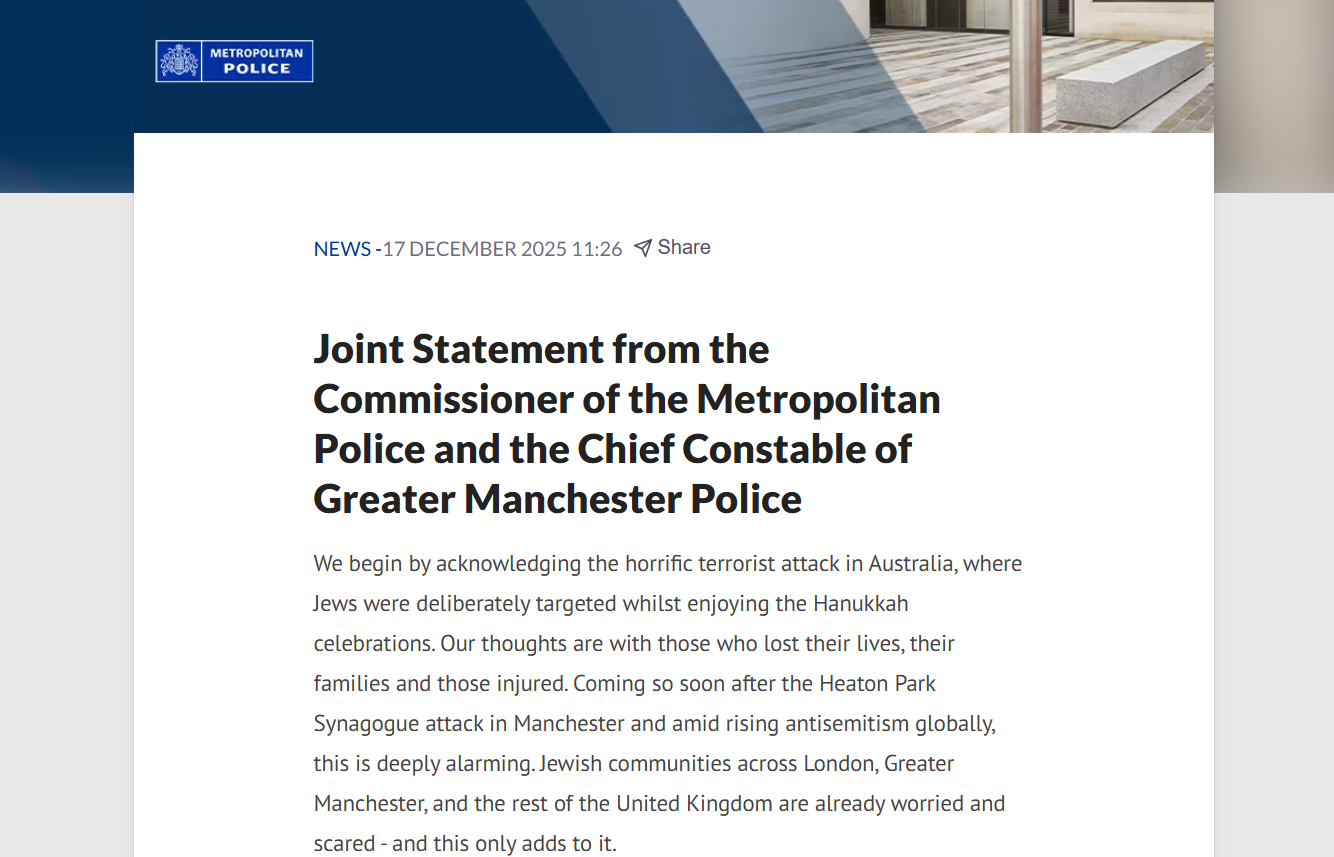
After Sydney, UK Police to finally act against the culture of hate
An incredibly important statement today (Joint Statement from the Commissioner of the Metropolitan Police and the Chief Constable of Greater Manchester Police) from the leaders of London and Manchester police in the UK, in recognition of long-term policy failures that have led to the murderous attacks on Jews in Manchester and Sydney. Those of us who have long studied and advised on political violent/terrorism have always been acutely aware that the societal environment - in particular the level of public tolerance for hatred and thus violence towards a particular group - is as important a factor in counterterrorism as understanding the ideology and tactics of terrorists. And this becomes ever more relevant as social media, augmented by state-led disinformation campaigns and AI, amplifies and spreads hate like never before.
At the heart of the problem is that past and present politicians, from across the political spectrum, have continued to underestimate and therefore failed to mitigate environments/social cultures that create public comfort of hatred. Hatred that directly leads to acts of extreme violence. This statement today clearly reflects frustration about this from these senior police figures (not that the police themselves can be absolved of some responsibility for this culture or for failing to stop some of these attacks) and their desire to put into the public domain that they are going to take action even before parliament gets to changing the law.
Over the years I have had many conversations with government officials and counterterrorism police about this - including with New South Wales Police themselves (I gave their Annual Lecture in Sydney a few years ago on terrorism threats) - trying to get across that counterterrorism will ultimately fail if wider societal dynamics are not examined, understood and embedded into policy.
One of those conversations I had, in Sydney, a few years ago - echoing others I’ve had all over the world - focussed on where counterterrorism resources should be allocated. The conversation revolved around a simplified framework for understanding communities when assessing threats of political violence: circles of green, yellow and red. The green is the vast majority of society/the wider community, that have nothing whatsoever to do with terrorism, while the people in the red circle are the terrorist themselves, those directly involved in or actively supporting acts of political violent. But my message was that a major priority should be on the other, less obvious circle, the yellow.
The yellow circle is the part of society/the community that may not be directly involved in acts of violence, but who share sympathy with the ideology or motivations of potential attackers. These individuals thus may not just turn a blind eye to the activities of potential attackers - making it much harder for authorities to find and stop them - but by proudly expressing support of their motivations foster an environment in which those considering terrorism believe that their actions are not niche but reflect widely-held sentiments.
And the evidence is clear throughout the history of terrorism, especially in the developed world - when those on the extremes believe that their beliefs have become widely held, the more likely it is that they will see violence as having wider support and thus as being justified. Extremist groups/elements that historically could only appeal to and recruit from a tiny minority, now find they have wider appeal.
My key message was that while the instinctive response of counterterrorism professionals and policy-makers is to think mostly about those in the red circle, they should in fact dedicate major resources to the yellow. 100 would-be terrorists entirely alienated from the wider community - isolated, easier to find, and thus easier to stop - are, in most cases, less of a threat than 10 terrorists enjoying ideological support from significant portions of the community. More acceptance means more attacks.
Working to stop people in our societies moving from green to yellow should thus have been recognised long ago as a top priority of our counter-extremism and counterterrorism - but from the UK to North America to Australasia it simply never has. This needs to finally happen (alongside programmes for example to deradicalise those who may be at risk from moving from the yellow to the red).
It has been the fundamental failure to recognise the growth of this yellow circle - and the role of the slogans referenced today in the London and Manchester police statement, that have been framed to sound like they are pro-Palestinian while in fact they can demonise and thus legitimise hatred towards the wider Jewish community - that has played a major role in the development of the antisemitism crisis we face in the Western world today.
The balance in a democratic society of course always has to be found between counterterrorism and rights like freedom of speech, and there are of course legitimate forums and spaces to protest and express sympathy towards Palestinians/opposition Israeli policies. But as the statement today states “All members of society have a responsibility to consider their impact on others – it is possible to protest in support of Palestinian people without intimidating Jewish communities or breaking the law.”
But without wider state-wide action - in the UK, Australia and elsewhere - that takes a long-term view on how to mitigate hate culture, such statements are meaningless.
And it is equally vital to recognise this isn’t just about Jews - acceptance of hate culture threatens all minorities, religious groups, etc, and it is a sad irony that many who will oppose the policing approach announced today. because they will see them as back door ways of stopping protest on Palestine, may be thankful themselves for such an approach and legislation if they become the subjects of targeted hate cultures in the future. All individuals and groups in our society deserve, and increasigly require, such protection.